01. Historical Context
FTSE MIB in context: what the current regime is actually pricing
FTSE MIB should be framed as a regime call, not a slogan. The relevant question is whether verified growth, inflation, and earnings conditions justify further upside from here, not whether a dramatic headline target sounds exciting.
| Horizon | What matters most | Current assessment | What would weaken the thesis |
|---|---|---|---|
| 1-3 months | Macro and earnings validation | Istat estimated Italian GDP up 0.2% q/q and 0.7% y/y in Q1 2026. | BlackRock's FTSE MIB ETF proxy showed 13.59x P/E and 1.79x P/B on March 27, 2026. |
| 6-18 months | Can profits outrun rate friction? | FTSE MIB has already done enough work that 2027 should be framed as consolidation plus earnings, not as a fresh blind rerating. Starting from roughly 49,291 on May 7, 2026, the highest-probability range is 55,461 to 56,740 if Italian GDP stays positive and the April inflation spike fades. | Rates stay restrictive enough to hit both cyclicals and bank multiples |
| To 2027 | Can the benchmark compound without a major rerating? | Base case remains data-supported | Repeated negative revisions or valuation compression |
FTSE MIB traded around 49,291 on May 7, 2026, based on Investing.com's historical series used only as a level reference. BlackRock's FTSE MIB ETF proxy showed 13.59x P/E and 1.79x P/B on March 27, 2026. Those two numbers matter together because they separate raw price momentum from the valuation investors are currently paying for it.
Istat estimated Italian GDP up 0.2% q/q and 0.7% y/y in Q1 2026. Istat's April 2026 flash showed Italian HICP up 2.9% y/y, from 1.6% in March. For a forecast into 2027, the market does not need perfect data. It does need enough evidence that earnings can outgrow rate pressure and concentration risk.
02. Key Forces
Five forces that matter most from here
The first force is starting valuation. BlackRock's FTSE MIB ETF proxy showed 13.59x P/E and 1.79x P/B on March 27, 2026. That matters because forward returns become more dependent on earnings delivery once a market is no longer cheap.
The second force is the latest macro mix. Istat estimated Italian GDP up 0.2% q/q and 0.7% y/y in Q1 2026. Istat's April 2026 flash showed Italian HICP up 2.9% y/y, from 1.6% in March. That combination tells you whether the market is being helped by genuine growth, a better discount-rate backdrop, or neither.
The third force is index composition. Italy's main equity benchmark, strongly geared to banks, insurers, energy, and industrial cyclicals. When a benchmark leans heavily on a few sectors or companies, leadership breadth matters as much as the macro tape.
The fourth force is institutional conviction. Public strategy notes in 2026 show that broader European risk appetite has become more conditional, especially after the March energy shock. That raises the bar for any bull case built mainly on rerating.
The fifth force is time horizon. A one-year setup can look stretched while a longer-run cash-flow story still works. That is why the scenario map below ties each range to measurable triggers and review windows instead of pretending one number can summarize everything.
| Factor | Current assessment | Bias | Bullish trigger | Bearish trigger |
|---|---|---|---|---|
| Valuation proxy | 13.59x P/E and 1.79x P/B on March 27, 2026 | Bullish | Profits hold up and the discount to broader Europe persists | Profits roll over and financials de-rate |
| Macro growth | GDP +0.2% q/q and +0.7% y/y in Q1 2026 | Neutral | Domestic activity and investment stay positive | Growth fades back toward zero |
| Inflation | HICP 2.9% in April 2026 | Bearish | Headline inflation quickly retraces the April spike | Energy pass-through keeps inflation elevated |
| Cyclical exposure | Banks, energy and industrials still drive much of the index | Bullish | European lending and capex stay resilient | Credit or industrial demand weakens together |
| Regional strategy view | UBS cut eurozone equities to Neutral in late March 2026 | Neutral | Energy shock fades and strategists rebuild exposure | Europe stays a tactical underweight |
03. Countercase
What would break the thesis
The bear case starts with valuation and rates. If inflation remains sticky enough to keep real yields high, higher-quality or higher-beta equity markets lose room for multiple expansion quickly.
The second failure mode is earnings disappointment. These benchmarks can tolerate only so much macro noise if revisions stay supportive. Once revisions deteriorate while valuations are no longer cheap, downside scenarios get easier to trigger.
The third risk is concentration. Markets with large weights in banks, defensives, semis, or a few national champions can appear diversified at the headline level while still relying on a narrow earnings engine.
| Risk | Latest data point | Why it matters | What to monitor next |
|---|---|---|---|
| Inflation relapse | April 2026 HICP 2.9% after 1.6% in March | Could slow ECB easing and lift discount rates | Istat inflation and ECB pricing |
| Bank concentration | The market still relies heavily on financial earnings | Makes the thesis sensitive to spreads and credit quality | Loan growth, CET1 commentary, cost of risk |
| Late-cycle rerating risk | Index already back near 49,000 | Raises the hurdle for upside without earnings follow-through | Revision breadth and full-year guidance |
04. Institutional Lens
What verified institutional work actually adds
Public strategy work does not give a clean FTSE MIB point target through 2027, 2030, or 2035. What it does show is that Italy sits inside the broader Europe cyclical trade: when strategists like UBS reduce eurozone exposure, FTSE MIB usually loses some of its valuation support faster than defensive markets do.
That makes the bull case earnings-led rather than purely sentiment-led. Italy does not need a U.S.-style technology multiple to work from here, but it does need the bank, insurance, and industrial complex to keep converting nominal growth into cash earnings.
| Institution / source | Updated | What it says | Why it matters here |
|---|---|---|---|
| UBS CIO Daily | April 1, 2026 | Eurozone equities downgraded to Neutral after the March energy shock | Important because FTSE MIB is one of the highest-beta large eurozone benchmarks |
| Reuters strategist poll | February 24, 2026 | European equities seen ending 2026 only modestly higher after a pullback | Supports a scenario map rather than a one-way melt-up thesis |
| GSAM Market Monitor | May 1, 2026 | Developed Europe at 15.4x 12-month forward P/E | Helps frame Italy's 13.59x proxy as optically cheaper but no longer distressed |
| FTSE Russell factsheet | January 2026 data cut | FTSE MIB had returned 24.8% over 12 months with 18.0% 1-year volatility | Shows the index entered 2026 after a strong rerating already |
05. Scenarios
Probability-weighted scenarios into 2027
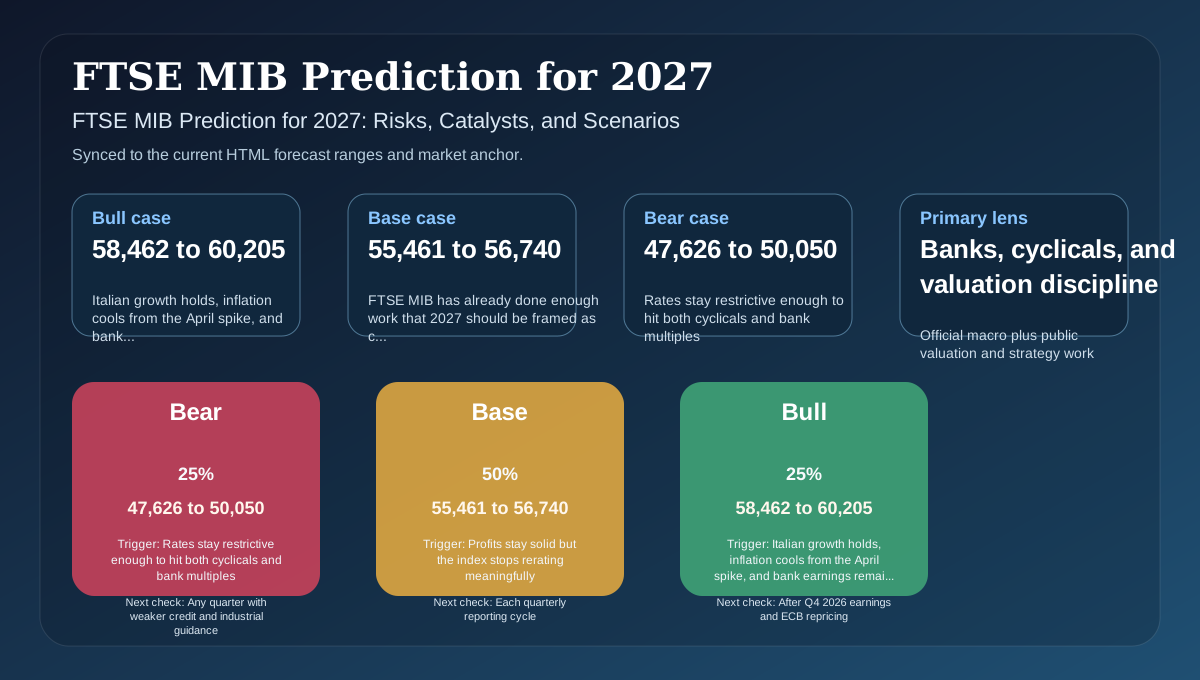
The 2027 ranges below are analytical ranges built from current valuation, official macro data, and named public strategy work. They are not presented as exact published bank targets unless the cited institution explicitly gave a target.
The base case remains the anchor because it asks for the least heroic assumptions. The bull case requires verified macro or earnings improvement. The bear case assumes valuation or concentration risk is no longer offset by hard data.
| Scenario | Probability | Working range | Measured trigger | Review window |
|---|---|---|---|---|
| Bull | 25% | 58,462 to 60,205 | Italian growth holds, inflation cools from the April spike, and bank earnings remain strong | After Q4 2026 earnings and ECB repricing |
| Base | 50% | 55,461 to 56,740 | Profits stay solid but the index stops rerating meaningfully | Each quarterly reporting cycle |
| Bear | 25% | 47,626 to 50,050 | Rates stay restrictive enough to hit both cyclicals and bank multiples | Any quarter with weaker credit and industrial guidance |
These ranges are not there to create false precision. They are there to make the decision process testable. If the triggers fail to materialize, the probability mix should change rather than the analyst simply defending the old story.
For readers already positioned, the practical question is whether the market is still compounding through earnings or merely levitating on sentiment. For readers with no position, the cleaner entry is still the one confirmed by data, not by narrative comfort.
References
Sources
- Borsa Italiana FTSE MIB index page
- Borsa Italiana FTSE MIB statistics, March 2026
- Istat preliminary GDP estimate, Q1 2026
- Istat consumer prices, April 2026
- BlackRock iShares FTSE MIB UCITS ETF product page
- FTSE Russell FTSE MIB factsheet
- UBS CIO Daily, April 1, 2026
- Reuters poll on European shares, February 24, 2026
- Goldman Sachs Asset Management, Market Monitor, week ending May 1, 2026
- Investing.com FTSE MIB historical data, used only for the May 2026 spot reference